Locale - Tenses and Tensions
The conundrum of the status of the image has engaged western thinkers from Plato and Pliny to Baudrillard and Blanchot. At the centre of this perennial debate lies the precarious condition of the relationship of the image to its object which, in effect, speaks both of its similarity and its difference. Moreover, this fissure, this gap, is exactly the space in which the image may separate itself away from its object, to endure, to persist. With the invention of technologies to make recordings of experience - visual and sonic images - came the interruption of the inexorable flow of time as the present fell into the past, in effect proposing then as now. Famously, Roland Barthes, contemplating a photograph of his dead mother as a child, noted the baffling and spectral tense of such images: this will have been. Each of the three artists in Locale, each with their own medium - the still photograph, the video, and recorded sound - offer us a rich investigation of what we might call ‘the grammar of the image’ at the heart of their practices.
Consider Peter Bobby’s unpeopled photographs of those immaculately styled spaces in show homes contrived in their every particular to seduce the viewer. Here we have the phenomenon of the doubled image, the image of an image, Bobby’s preened photographic surfaces acting as both relays and amplifiers, transmitting these glossy confections with a transparent fixity. For these spaces and the objects which inhabit them are fixed images too, every flower a generic image of a flower, every abstract painting a generic exemplar in a perfect harmony with the untouched and untouchable soft furnishings, all contingencies erased in pursuit of ideal, aspirational spaces. Their glossy perfection is hard won and immaculate - a word which, in its Latin origins, means ‘without stain’. The price paid for this condition is the abolition of time itself, since that would render the spaces vulnerable to the contamination of contingency, the stain of change. No, these vases, we sense, cannot move or be moved, these chairs need their exacting symmetry, the concealed light sources must perpetually regulate and smooth out all possibilities of ebb and flow. In effect, these photographs offer us a tenseless present: this will have been, the future anterior, is replaced by a glacial ‘this is’. The stillness of these spaces and the objects within them is best conveyed by the term ‘stock-stillness’, a term that defies logic in its redundant doubling of the absolute term ‘still’ but satisfies experience. However, this alluring promise of stasis, this abolition of the future tense, is, in truth, curdled with contingency: for these are in fact photographs of temporary constructions, honed to a honeyed but fleeting perfection. Bobby’s photographs would appear to conspire in the seduction as there can be no ‘decisive moment’ in his delivery of this mythic, perpetual present; he does not wait for the prefabricated unit to be removed from the site or the construction to be demolished or for the unit to be made over in order to sell the next phase of the development.
Yet, just as these photographs offer relish and delight in the perfections they portray, a closer look reveals some ripples disturbing their ostensibly imperturbable surfaces. For Bobby makes the most discreet and precisely gauged interventions: an elided space here, an unexpected reflection there, or a blank walled hiatus separating one zone from another, signalling exactly sufficient to detain and sustain our contemplation. He makes us think about these spaces which have been designed with the intention to undo thinking, to hide their ideology of aspirational consumerism under their artful transparency. Paradoxically, by arresting and stabilising these images, he returns time to them - time to think.
Paul Kilsby 2005
Space - The Final Frontier
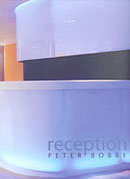
If we look into a typical Peter Bobby photograph, what do we see? More obviously maybe than most artists, Peter Bobby depicts space. In the usual terms of pictorial representation we witness of course the collapsing of three-dimensional space into two dimensions, in a way, which both fools and soothes the eye. This is a trick propagated since renaissance times and essentially what our conception of realism is founded on. I would like to put forward the proposition that in his depiction of corporate space Bobby lays out before us a 4th dimension for our contemplation - Time. The pictures represented in this book construct a complex critique of the space / time corollary, and one which is wholly pertinent to anyone interested in the workings of the photographic medium.
Most of the spaces rendered in Bobby’s large-scale images and in particular the reception areas exist on the cusp of design and function and are as yet brand new. Peter Bobby, after the philosopher Marc Augé has deemed these spaces ‘non-places’ where a person is “relieved of his usual determinants” and because it is a transitional spaces, is suspended from everyday life temporarily for the time it takes to transport us from one place to another. This is of course the function of a corporate reception area, and Augé has described these non-places as “the environment of the moment”. Logically we could conceive this to be negative space.
It seems to me that Bobby’s depiction of the non-place is indicative of the contemporary photographic moment. In cosmology negative space would equate to anti-matter both in binary opposition and in it’s ‘otherness’. Photography, for so long the faithful servant of nature and the ‘real’ is changing it’s allegiance, it is switching polarities as it’s initial project is exhausted and at long last it’s mission may be no longer merely to enlighten – but to peer into the darkness, and attempt to try to re/present the unrepresentable. Read this way Bobby’s images show a delicate balance between the depiction of appearances and the capacity for allegory. The hard smooth shiny surfaces which fill the constructed spaces with the signs of human agency merely speak metonymically and forlornly of the human form. The commercial dream image of utopian perfection via exchange is appropriated and undercut by the artist’s re-contextualisation , and the ‘unrepresentable’ facts seem to be the sense of loss and alienation that modernist progress often seems to induce. This veneered hyper- reality, manifested metaphorically in the large and grossly glossy Perspex bonded prints, may be merely a beautiful seduction, a chimera with no substance, a veil of appearance covering a false idolatry of biblical proportions. The artist however does not tear down these false edifices, but he does deconstruct them. Peter Bobby shows us what we have created and we are at once amazed and aghast.
Through his strong affiliation to the correlation between absence and presence Bobby shows us a present concerned with surface gloss and sheen – as beautiful and possibly pointless as Britney Spears. What’s missing is humanity, and what is revealed is the space between corporate/institutional space and personal space.
The strategies employed are beautifully pure and concise, Peter Bobby has no room for a Barthesian punctum, no aura either; in fact Walter Benjamin’s ‘aura’ seems as he himself remarked on another occasion, to have been sucked out of these spaces like the air out of a sinking ship. So much then for the pristine and sterile interiors contained within, if they are vacuum packed then what lies outside? There must be an antithesis to the non-place; like any demarcation of space these images also allude to that which is not present, the allegorical impulse which is at the core of photography - to speak “other than itself “. Bobby’s images, like little pockets of pure culture are reminiscent of the 17th century walled garden with all its signifying plantings and statuary begging the question, what lies beyond the walls? The answer is of course ‘nature’ in all her terrifying and unruly sublimeness. These reception areas are time collapsed; they are the future now. The non-place is balanced by a sense of place, matter by anti-matter, absence by presence: indeed if the vacuum is the void then it should be surrounded by pure presence. If Bobby’s images contain the air of the future then they must be surrounded by the weight of the past, and if we were to turn to look through the inevitable plate glass wall to the outside we may well see Friedrich Nietzsche quietly going mad in the street.
Now let us return to Augé’s interesting phrase “the environment of the moment”. Clearly these photographs represent an untarnished sterile space, in which every surface shines and every object is placed with such precision that they can only exist in the split second in which they are photographed. This evokes the basic equation of the photographic image, i.e.: illuminated space divided by time. A space/time correlation which Bobby’s best work brings into sharp and shimmering focus. It’s only obvious in the restating but photography is in essence a time-based medium. Implicit in photography is the performative act, however obtuse that may appear at times and in that sense the instant is as vital to representation as the minute the hour or the day. Walter Benjamin, photography’s first true critic, once mourned the onset of photographic technology as he saw something particularly magical in the work produced in the first decade or so of the medium, and he attributed this to the peculiarities of the long shutter times. This of course was most apparent in portraiture but Benjamin’s theory was that the incomparable fascination of these early portraits came about because the subjects existed wholly within the photographic moment. With an eight second exposure this of course was possible but with the onset of very short shutter speeds which really were instant, then it was Benjamin’s conclusion that by necessity the subject (maybe the aura or humanity or something magical and poetic was missing) was forced to reside outside of the photographic moment. Under the mistaken impression that time was conquered photography turned inevitably to the ordering of space. This is a now arcane and much neglected theory but I feel it has much bearing and usefulness in any interrogation of Peter Bobby’s work.
Because of Bobby’s decision to photograph as the space is in transition between concept and function then the space is in clinical suspension until the arrival of man and the onset of functionality. I would argue here that ‘time’ for this space will only commence in a real sense with the arrival of man – man is the mark, man is the measure (homo mensura). Subsequently Peter Bobby’s photographic moment is open ended and could easily last for decades until someone finally breaks the silence and puts a footprint on the finely lacquered surface. With that footstep time will be regained. This interpretation, arrived at through long perusal of the photographs asserts then that it is time and not space that ultimately has prior call on us and promotes the level of fascination that Bobby’s images undoubtedly have. A contemporary and provocative conception of photographic representation can be arrived at through such an examination of the work; one which recognises that in part the perceived exhaustion of the medium is due to the insistence on the privileging of the spatial over the temporal. These reception spaces although shiny and bright and colourfully seductive are seen as surface in all respects. Like 17th century Dutch genre painting the images promote the flat surface at the expense of the illusion of 3 dimensions (and this of course as in the Dutch works in spite of perfect renderings of perspective). Svetlana Alpers has referred to this phenomenon as the ‘art of describing ‘. What really resonates through the photographs though is the sense of suspended time. Suspended in their Perspex resin the images defy the passage of time and at once extend the moment to infinity. To over privilege the spatial is a continuation of photography’s old contract with the concrete and the rational, as the medium slowly breaks these ties then the photographic moment needs to be freed from it’s spatial concerns. Peter Bobby intuitively goes some way in his work towards Walter Benjamin’s wish that photography be once again allowed to reside ‘within’ the moment.
Of course the images function in many ways and on a perfunctory level, without their elevation in terms of scale, their new objecthood, and recontextualisation in a gallery environment, they will serve admirably as record for late 20th, early 21st century corporate design. But it is this rupture of context that quietly subverts commercial representation and as a result critiques and obfuscates the seductions of late capitalism. It is in the temporal however that their power lies. All photographs mark the passing of time but these have something of the embryonic about them. As perfect newly borns these spaces have limitless potential, their narratives are all in front of them. They resonate with the power of disasters waiting to happen. It also means though that Bobby’s photographic instant/moment has infinite possibilities too, and it is an instant potentially loaded with significance and capable of swallowing whole narratives in one unifying moment rather like an astronomical black hole. The instant here is a gateway, a portal, open ended and awesome. A dense instant then that has no bounds, unlike the petrified image of Cartier –Bresson’s decisive moment which was really predicated on the ordering of space and in effect froze time, diminishing it’s power to influence the reading of the image.
It may seem at first glance that these readings fly perversely in the face of photographs that are so obviously about space, but in Peter Bobby we have an artist who has an interest in the philosophical and an understanding of the strategies of representation precise enough to allow interpretive formulations that not only serve to enhance the work, but also question our understanding of our environment, our place therein, and our passage through.
Paul Jeff 2003
|